
How We Choose Our Lab Partners
Choosing a third-party test is about much more than just getting a lab report back. The laboratory that conducts the test has to be impartial, have the right equipment to perform tests properly and repeatedly and be able to generate reliable and reproducible data.
Here at Niro, selecting a laboratory is viewed as a critical part of the quality assurance process. Our partners performing analytical testing must be assessed and approved against a rigorous set of criteria which help provide scientific integrity and confidence in each COA we receive.
Why Independent Testing Matters
Third-party testing is only reliable if the entity performing the tests are truly separate from the material’s supplier. If a lab has an ownership or financial stake with a supplier, their results can be compromised.
Historically, the research supply industry has a history of a lack of transparency where suppliers will call testing “independent,” when it’s clear the relationship doesn’t stand up.
To circumvent conflicts such as this, we have only chosen to work with labs that are independently owned and operated and hold proper accreditation for quality.
ISO 17025 Accreditation: A Required Standard
The starting point of our lab selection is the accreditation status. All analytical testing laboratories we are dealing with are required to be accredited with a recognized national accreditation body and part of the International Laboratory Accreditation Cooperation (ILAC) system.
The ISO 17025 standard is the internationally recognized quality system which prove technical competency of a laboratory. The accreditation confirms that the lab has defined and documented its methods, calibration procedures, quality control and management system for testing methodology and technical competency. All methods, instrumentation, and processes used in testing have been vetted and proven to meet specific requirements for quality and accuracy. Method verification and validation, data integrity and documentation practices all are part of the standard.
Accreditation of each testing lab we work with is confirmed by an independent verification process before cooperation begins. The status of the expiration date is regularly checked, to make sure that our business partners have a valid certificate for testing.
In the event that a lab’s accreditation expires and could not be confirmed, our testing shall be put on hold until its accreditation is restored.
Evaluating Analytical Method Validation
Laboratory accreditation demonstrates overall competence, but it does not automatically confirm that a specific analytical method is appropriate for every type of material.
For this reason, every testing partner must provide documentation demonstrating that their analytical methods are validated for the compounds being evaluated.
For identity verification and purity testing purposes, we will examine several key validation properties:
Specificity
We will analyze the ability of the analytical procedure to unequivocally assess the target compound in the presence of impurities, including potential variants, degradants, and synthetic by-products.
Linearity
The testing method needs to provide predictable and proportional responses over the expected range of concentrations.
Precision and Repeatability
The method will show that repeated measures of the same sample consistently yield comparable results over a period of time, providing a consistent dataset.
Detection and Quantification Limits
The analytical procedure will have the ability to accurately measure low levels of impurities, especially when impurity levels are less than one percent.
Maintaining Laboratory Financial Independence
But independence isn’t solely about ownership. Sometimes, the finances can put you in a position to be swayed.
To maintain the integrity of testing, primary laboratory partners must be independent financially from Niro. If the majority of a lab’s business comes from Niro (or companies associated with Niro), it cannot be a primary lab partner.
Financial independence is verified through written confirmation during onboarding and reviewed periodically to ensure continued compliance.
Split-Sample Cross-Validation Testing
Even after you’ve chosen your lab partner, quality control continues. Independent testing, or cross-validation, is run to ensure that your results are accurate.
From time to time, the same material batch is submitted to multiple independent laboratories for analysis without informing either laboratory that parallel testing is occurring.
If testing results differ beyond established acceptance limits, the discrepancy is investigated before any final documentation is issued.
By doing so, you are assuring that consistency exists between your labs and your testing partner will be kept accountable for their relationship.
Transparent Testing Timelines and Quality Controls
When designing a comprehensive quality process, it’s essential that you have both accurate testing and reliable documentation turnaround times. Your lab partners function with contractual agreements that set expectations for when services are to be rendered.
Materials are not released based on assumptions or incomplete testing. A product batch must complete the required analytical testing process before documentation is finalized.
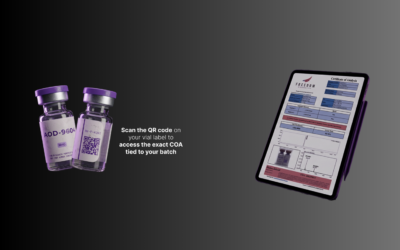
Every vial shipped from our facility is supported by a completed and archived Certificate of Analysis that corresponds to the tested batch.
Our Commitment to Laboratory Transparency
Choosing the right testing partners is one of the most important steps in maintaining research material quality. Independent laboratories, validated analytical methods, financial separation, and ongoing performance monitoring create a stronger quality assurance system.
We apply rigorous laboratory selection criteria to deliver a documented study that researchers can confidently and transparently analyze.